How to Relax Before and During a Freedive: Techniques That Truly Work
Most people come to freediving thinking in terms of breath-hold time or finning strength, but long before those aspects matter, relaxation determines how the dive will unfold. A relaxed body uses less oxygen. A relaxed mind equalises more easily. A relaxed freediver moves with the water instead of fighting it.
In this article, we’ll explore relaxation before the dive, relaxation during the dive, powerful techniques to support both (mental anchoring, mantras, visualisation, body scan, diaphragmatic breathing, positive thinking), the main zones of the body to relax, and finally the yoga practices associated.
1- Before the Dive: Creating the Right Internal State
The 180 seconds leading up to the dive shape everything. Your mind, breath and muscles should all move toward the same direction: softness. Pre-dive relaxation is not about “becoming slow” or “zoning out”; it’s about settling into a quiet state of the mind and of the body.
Diaphragmatic breathing: The switch into calmness
Diaphragmatic breathing is the simplest and most reliable way to shift your nervous system into relaxation mode. When you breathe from the belly rather than the chest, your heart rate naturally drops, your body stops producing tension hormones, and your breath becomes economical instead of active.
A simple pattern:
Inhale gently for about 4-5 seconds
Pause for 1-2 seconds
Exhale slowly for 6–8 seconds
Nothing is forced. No “big breaths,” no hyperventilation. The breath should feel warm, round, and smooth. After 3–5 cycles, the body already begins to slow down.
Mental anchoring: Coming back to the present
An anchor is something simple you return to when your mind starts spinning.
It can be:
the sound of the water
the feeling of the rope on your fingers
the weight belt resting on your hips
your heartbeat
Pick one and use it each time your mind starts anticipating the dive. Mental anchoring prevents those last-minute spikes of tension that sabotage your relaxation.
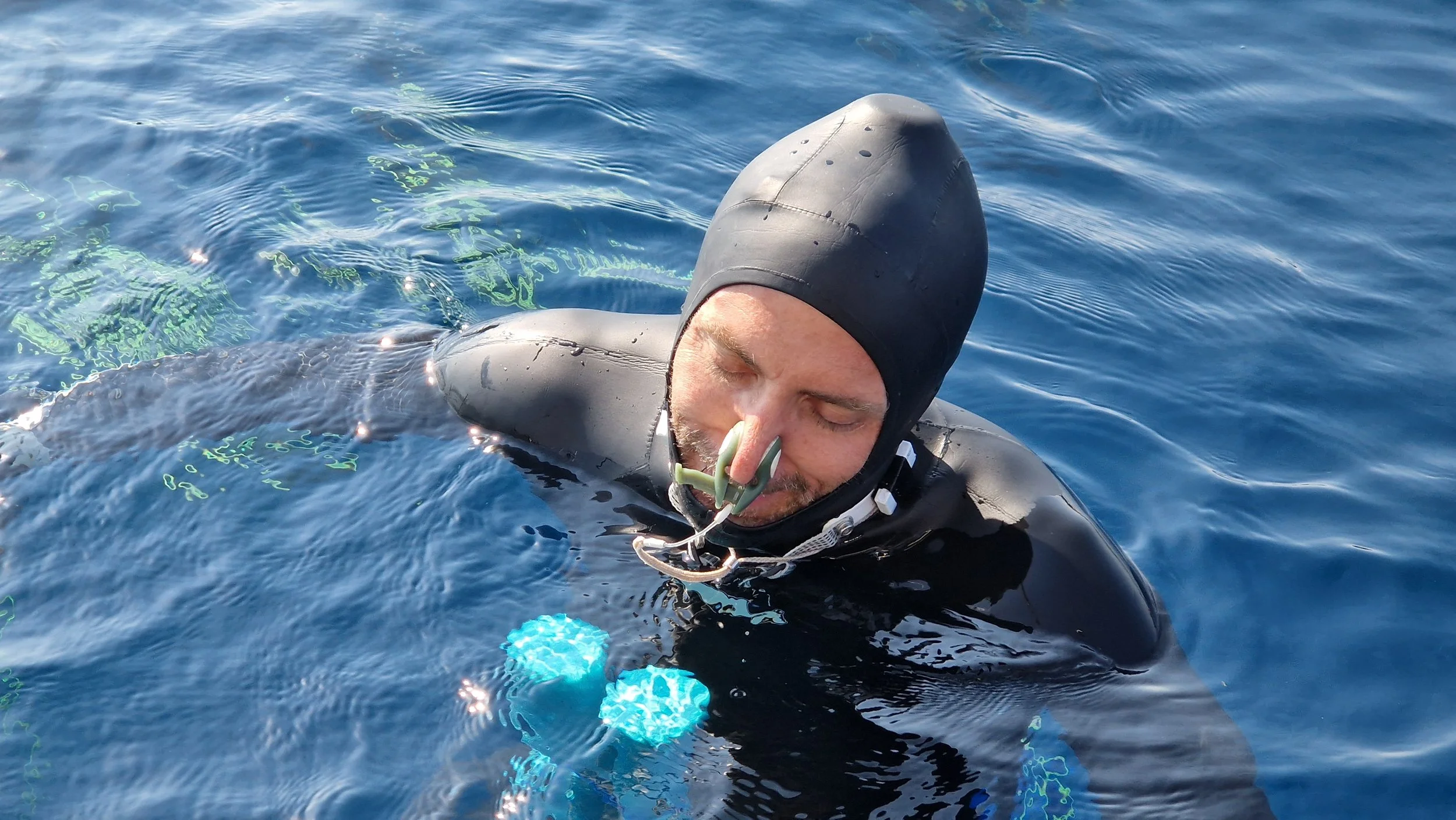
A freediver relaxing his mind before his dive
A quick Body-Scan: Releasing hidden tension
We all carry tension without noticing it — forehead, jaw, shoulders, hips, thighs. A 30-second body scan helps clear all of that.
Move your attention from top to bottom:
forehead relaxed
jaw soft
tongue relaxed inside the mouth
shoulders lowered
ribs soft
hips heavy
thighs and feet relaxed
You’re not “collapsing.” You’re removing unnecessary effort.
Visualisation: Rehearsing the experience
Visualisation isn’t about imagining a number or a goal. It’s about feeling and living the dive before it happens.
Picture during 2-3mn:
the entry into the water
a slow, clean finning
your equalisation is happening smoothly
the buoyancy disappearing
the moment you start to free fall
If the visualisation feels calm, the dive often follows the same pattern.
Mantras: Creating Rhythm
A mantra is like an internal guide. Short, personal, and quiet.
Some freedivers repeat:
“I am here and now”
“I am at peace, in harmony”
“I am safe”
If you possess a personal mantra, you can repeat it , and connect to it’s rythm and energy. This is a great way to quiet the mind and build up confidence before the dive.
Positive thinking: Supporting yourself instead of fighting yourself
Freediving becomes harder when your own thoughts turn against you.
Simple mental shifts make a huge difference:
From performance → curiosity: “Let’s see how it feels today.”
From forcing → accepting: “The dive will be whatever it needs to be.”
From doubt → trust: “My body knows what to do.”
Relaxation grows where trust grows.
2- During the Dive: Moving With Less, Feeling More
Once you begin your dive, you’re no longer preparing , you’re participating. The goal becomes conserving energy, avoiding unnecessary movement, and letting the dive reflex take over.
Shoulders & Neck: The first zone that tightens
Almost everyone raises their shoulders or tightens the neck when equalising.
Try to:
look straight at the rope ahead. Ideally you should be able to see the surface at the bottom of your mask or goggles.
let the shoulders fall naturally
keep equalisation soft rather than “pushing”
When the neck is calm, equalisation usually becomes more fluid.
The Diaphragm: Softening Instead of Resisting
Hydrostatic pressure compresses the chest at depth. If the diaphragm fights this natural compression, the body wastes oxygen and stress builds up.
The key is to:
relax the lower ribs
allow the chest to reduce in volume without resisting
A soft diaphragm is one of the strongest markers of a relaxed diver.
Mula Bandha & the pelvic floor
Many divers subconsciously tense the pelvic floor, especially during the first meters of descent. This creates stiffness through the whole torso and makes equalisation less efficient.
Focus on:
unlock the perineum
lower abdomen soft
glutes released
Think of the torso as a single, flexible piece rather than a set of independent muscles.
Ankles: The joint that changes everything
Stiff ankles create drag and reduce propulsion.
Try to:
keep the ankle extended but soft
avoid over extending your feet
let the fin load and unload naturally
Relaxed ankles mean more glide, more efficient propulsion, less oxygen consumption.
Freefall: The moment relaxation peaks
Freefall is where freediving stops being a physical activity and becomes a sensation.
No effort. No noise. No tension. Ideally it should be a moment of utter peace and bliss.
Enjoy:
arms drifting
gentle equalisation
the mind stilness
a totally body passive
If pre-dive relaxation was well done, this phase feels like the ocean is carrying you.
3- Yoga practices that support deep relaxation
Yoga and freediving naturally complement each other. Both rely on breath control, body awareness, and the ability to shift the nervous system toward calm. Two yoga practices are particularly powerful for freedivers: Śavāsana and Yoga Nidra.
Śavāsana: The Art of Conscious Rest
Śavāsana (the “corpse pose”) looks easy—lying on your back, doing nothing. But true Śavāsana is a practice of letting go, layer by layer.
Benefits for freedivers:
releases micro-tensions in the whole body
teaches you how to “switch off” unnecessary muscles
improves breath sensitivity
trains stillness without discomfort
Some freedivers practice Śavāsana during breath-up, floating on the surface.
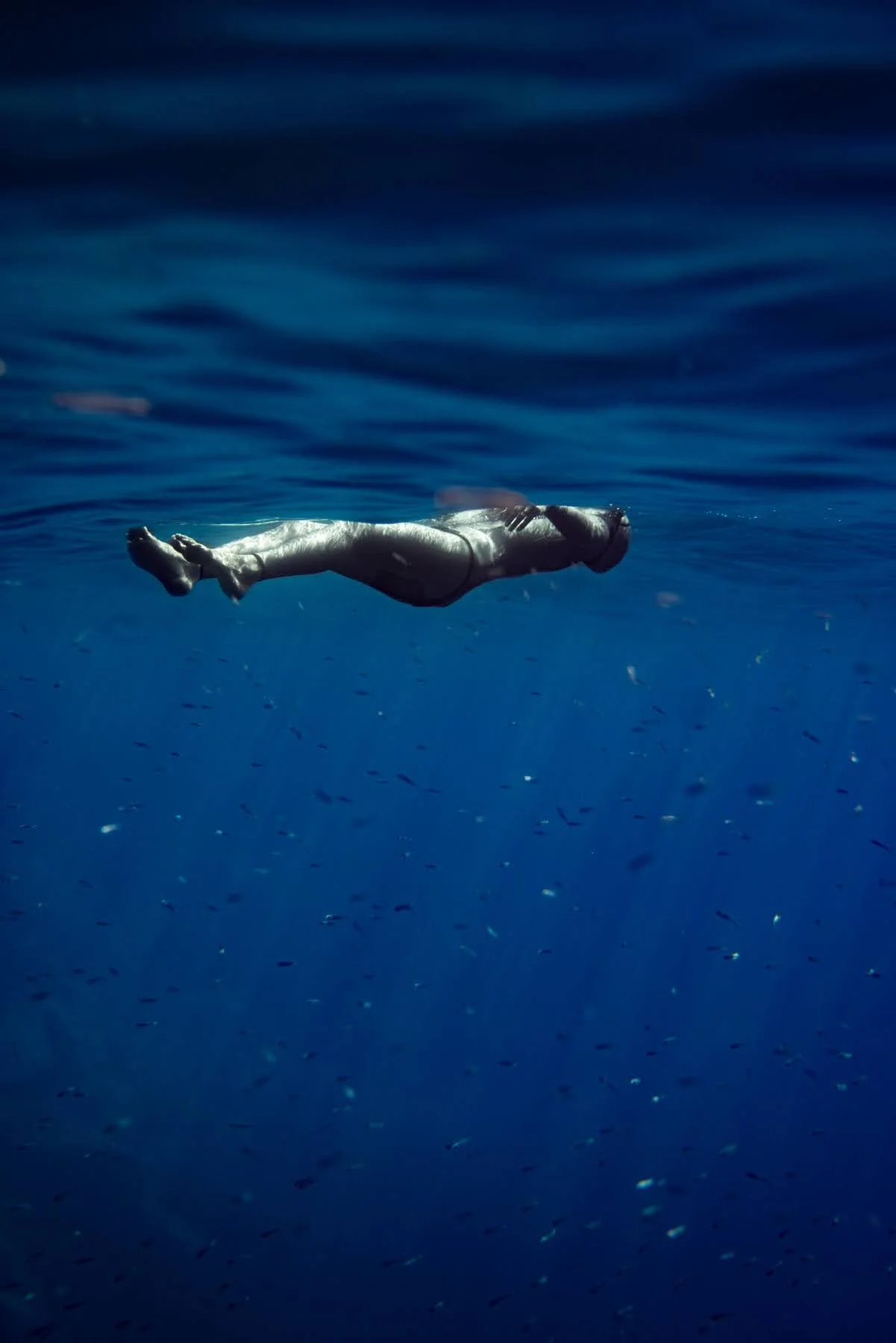
A freediver in savasana relaxing his body and mind
Yoga Nidra: Deep Relaxation for the Nervous System
Yoga Nidra is guided meditation performed lying down.
It works through the body and mind step by step:
body scanning
breath awareness
visualisation
quiet attention
It brings the body into a state close to sleep while the mind stays awake.
For freedivers, this is gold:
heart rate drops
stress hormones decrease
the body learns to remain still without tension
anxiety decreases
mental images become clearer (useful for dive visualisation)
Practicing Yoga Nidra once or twice a week builds a strong relaxation baseline — what freedivers often describe as “feeling soft inside.”
4- Conclusion: Relaxation is a trainable skill
Relaxation in freediving is not luck, talent, or personality — it’s a trainable skill.
With the right habits, it becomes part of your muscle memory:
diaphragmatic breathing sets the tone
anchoring and mantras calm the mind
body scans release tension
visualisation prepares the nervous system
yoga cultivates inner quiet
and during the dive, each area of the body knows how to soften
When relaxation becomes familiar, dives feel smoother, deeper, and more enjoyable — almost effortless.